Time is running out
Figure out what you need to do and get to it

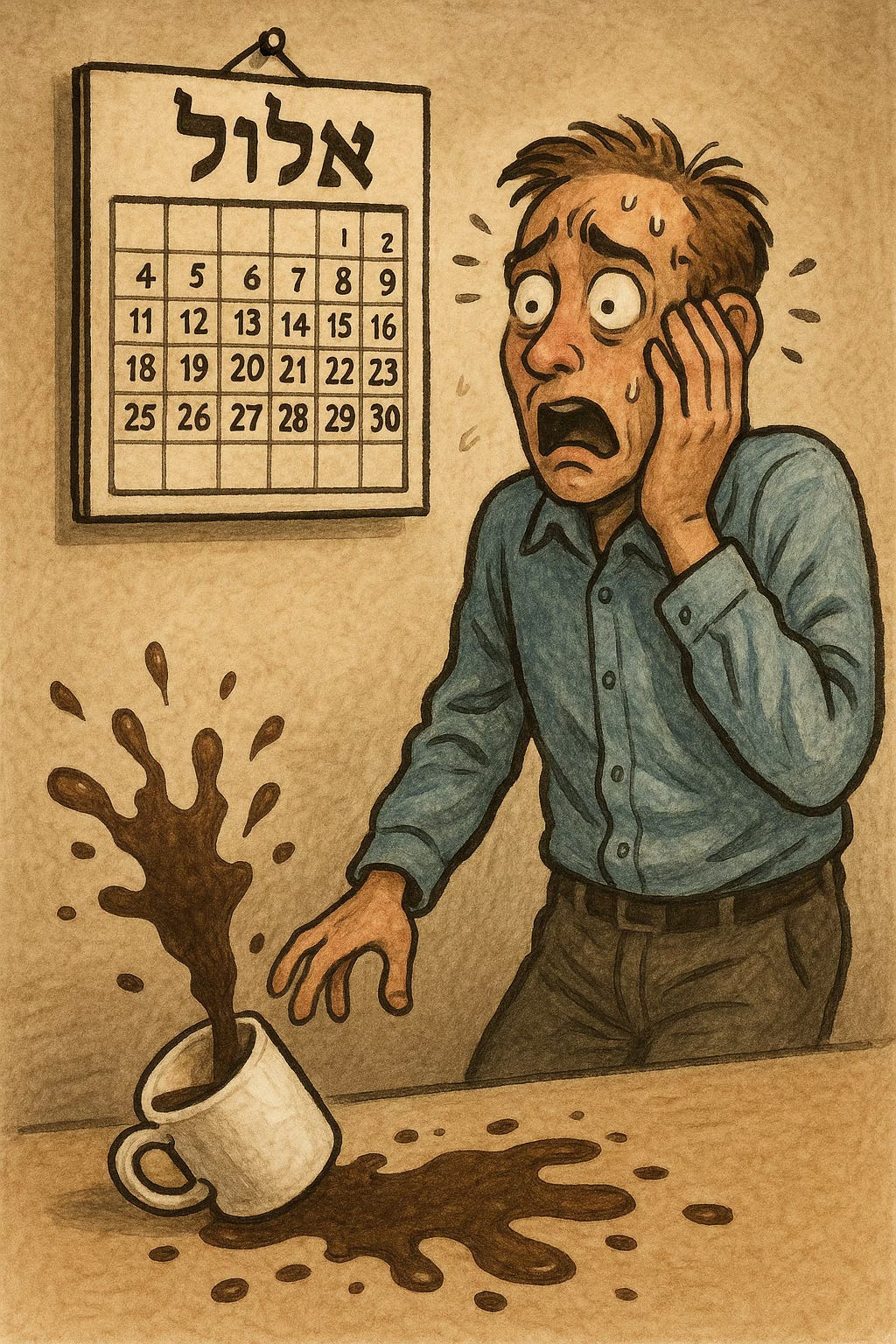
The queasiest moments in being a religious human are those that require prioritization of a devotional act over a relational one. When something between us and God - say, kashrut, or Shabbat, or a holiday - takes precedence over something between us and another human, it feels awkward. Like, that is so nice that you made me food but I can’t eat it because it’s not kosher. I’d love to chat, but I have to go do the afternoon prayer.
It is only natural that we want to take care of our people and make them happy, but the reality is that our relationships with other people are not the only center of Yiddishkeit, and they occasionally get pushed to the side. It is not entirely rare that we are disappointing someone we love because of a religious obligation, or because of some other moral standard to which we are devoted, and it doesn’t feel good.
There is, perhaps, no more shocking and extreme example than the one we find in this week’s Torah reading. After a long preamble, Moshe finally begins outlining the laws that the Israelites will have to know as they enter the land. The first set of laws pertains to idolatry - destroying the idolatry infrastructure being used by the inhabitants of the land, resisting the urge to mimic their behaviors, and rejecting (and ultimately killing) a prophet who encourages you toward idolatry. And then this: “If your brother, your own mother’s son, or your son or daughter, or your wife, or your closest friend entices you in secret, saying, ‘Come let us worship other gods’… do not assent or give heed to any of them. Show no pity or compassion, and do not cover up the matter; but take that person’s life. Let your hand be the first to put that person to death, followed by the hand of the rest of the people.”
Who could imagine such a thing? Who would ever agree to actually do that?
The point is clear, though: in the absolute case, our interpersonal relationships cannot and do not override our relationship to God. In no way does an interpersonal mitzvah bein adam l’cheveiro - “between one person and another” - automatically override a devotional mitzvah bein adam la’makom.
But that is not an excuse to focus most or all of their religious energy devotionally. And, unfortunately, I’m the kind of person who tends that way. Due to some recent circumstances, I have had to confront the reality that my interpersonal mitzvah instinct is lacking and weak, and it matters.
I’m comfortable in Bein Adam Lamakom - devotional space. I’m good at praying and learning and writing. I put on an extra set of tefillin every day. I even do an extra tefillah, out in the woods, in the dark. But I’m worse at the people stuff than I care to admit. And it’s time to deal with it.
This is Shabbat Mevarchim Elul, the Shabbat that precedes the first day - rosh chodesh - of the month of Elul. They say that in the old days, if you just said the words rosh chodesh Elul, people would start crying. People would immediately realize how far they are and that you can’t put it off anymore and you need to get to work.They’d tremble knowing that Rosh Hashanah, the Day of Judgment, is around the corner.
People love to talk about how the name of the month, Elul, is an acronym for Ani L’dodi V’dodi Li. It’s a phrase from Song of Songs, and it means “I am devoted to my beloved and my beloved is devoted to me.” People seem to really like that. I’m not sure how it changes things and moves the needle. I don’t know what it reminds people to do, or how it helps them change. But it sounds nice. It gives a nice, vague framework for Elul. Like, oh yeah, I should probably love Hashem this month. (By the way, the harder part is the second part, letting Hashem love you. Maybe we’ll explore that another time.)
But there’s a much more important and urgent acronym for Elul, from the story of Purim, Megillah Esther. “Ish L’re’ehu U’matanot L’evyonim.” On Purim, people have to “give food gifts to each other, and also give gifts to the poor.” It’s Bein Adam L’Chaveiro - interpersonal. And it is acronymed into Elul to remind us that we have to do maintenance on our friendships and also take care of poor people.
Elul isn’t in shul. It’s in the field. We hear the shofar in the morning, and it’s like marching orders, and we get out there and see what’s happening and see what we need to address and fix it to the best of our ability. Go make sure your friends are OK. Go check in on the poor people.
The old kabbalistic books assign different limbs to different months, and Elul is the left hand. Rabbi Shlomo Carlebach points out that it is the weak hand. It’s not the things you’re great at. It’s the weaknesses. The arm you put tefillin on because it needs to be powered up.
Do you have the courage to look at what you’re not good at, at the relationships that have fallen away or broken down? You know how people go to their best friend and say “Do you forgive me? I forgive you”? Waste of time. Go to the guy who’s not returning your calls and beg him to listen to you and beg for forgiveness. That’s Elul. If Elul is hard you know you are headed in the right direction.
(Paraphrasing) No individual person bears any measurable significance compared with the whole of creation. —RAMBAM, Guide for the Perplexed 4:11-12. we tend to elevate the human ego in our daily lives while the rest of the creations on earth burn. Clearly we are off the mark.